NASA selects project to explore whether a Moon pit leads to a giant cave
ScienceDaily · 5 October 2026
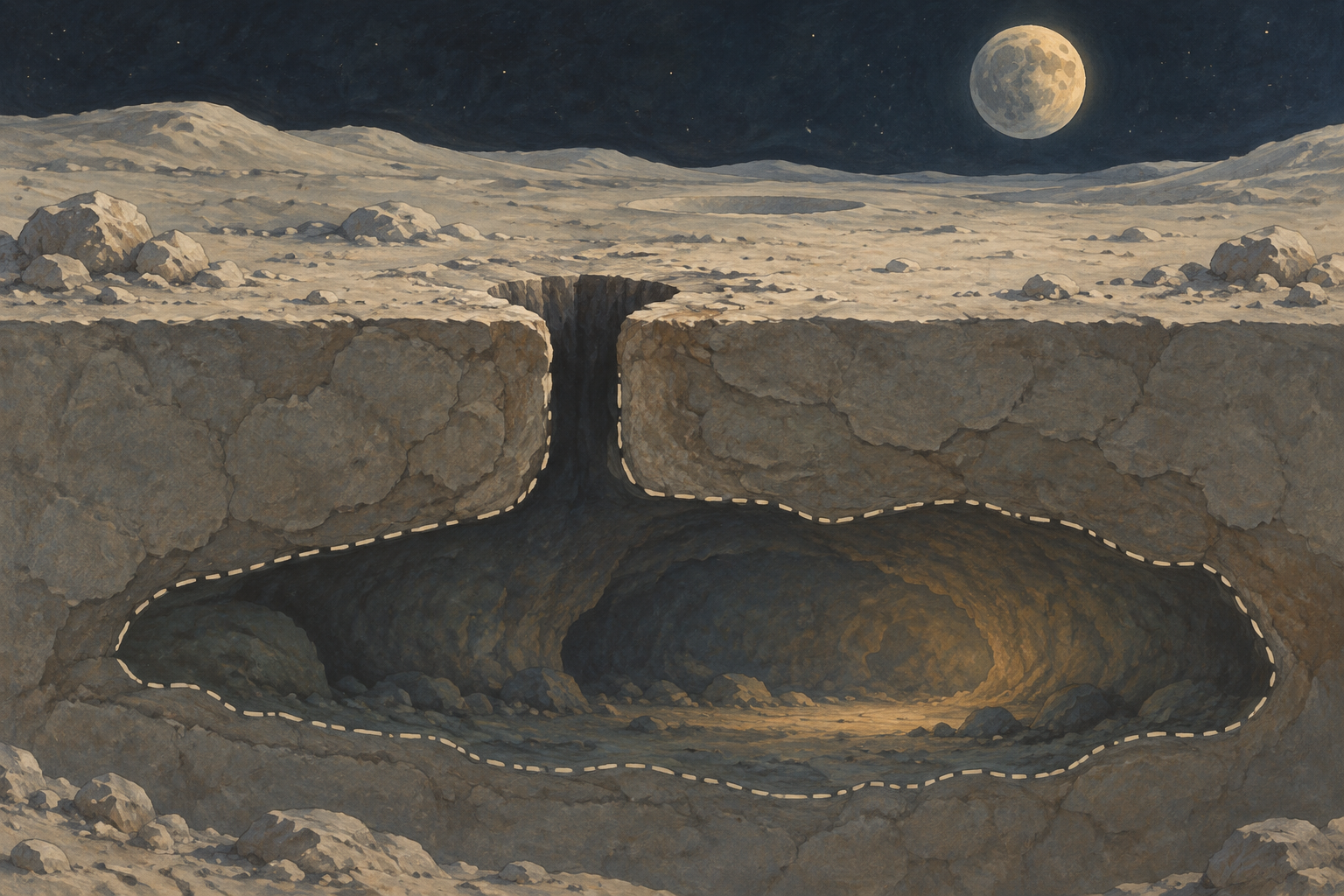
A hole on the Moon could be an entrance to a much larger underground space. NASA has selected the GIMLI project to investigate beneath the Marius Hill Pit, looking for a cave that might hold clues to ancient volcanic activity and, potentially, offer shelter for future astronauts.
In plain words
Imagine finding a hole in a garden and wondering whether it is just a deep dip or a doorway into a hidden cellar. Researchers face a similar question at the Marius Hill Pit on the Moon. GIMLI will use several kinds of measurements to look for empty space beneath the surface and estimate how big it might be. The important distinction is that NASA has selected a project to investigate this possibility: the excerpt does not report that a giant cave has already been confirmed.
What happened
NASA has selected GIMLI to investigate whether the Marius Hill Pit connects to a large underground cave or lava tube. The central question is about what lies beyond the visible opening: is there a substantial hidden space beneath the lunar surface?
Researchers plan to combine radar, measurements of ground vibrations and gravity, and camera images. Their aim is both to search for a cavity and to estimate its size if one is present.
The excerpt identifies two reasons for looking. A cave could preserve evidence of the Moon’s volcanic past, and an underground space might offer protection for future astronauts. Neither a vast cave nor a usable astronaut shelter is reported as a confirmed finding.
The background you need
The Moon has a volcanic past. As general background, some of its landscapes formed when molten rock, called lava, spread across the surface and cooled. Those ancient flows can leave structures that help scientists work out how the landscape developed.
One possible structure is a lava tube. This can form when the outside of a flowing stream of lava cools into a solid crust while liquid rock keeps moving underneath. If the liquid drains away, it can leave a tunnel, rather like a pipe after the water has run out. A hole in the roof can expose part of that underground space, although a surface pit alone does not establish how far a cavity extends.
Underground shelter is interesting because the Moon has almost no atmosphere to protect its surface. In general, a thick layer of rock can help shield against harmful radiation, incoming small space rocks and large temperature swings. That makes lunar caves worth studying, but it does not automatically make any particular cave safe or suitable for people.
How they found out
The excerpt describes a planned investigation, not completed results. GIMLI will use radar, seismic sensors, gravity measurements and cameras to search below the lunar surface and estimate the size of any hidden empty space. It does not explain where the instruments will operate or how they will be deployed.
In this kind of investigation, radar typically sends out radio waves and examines returning echoes for signs of buried boundaries. Seismic sensors measure vibrations, whose passage can reveal differences inside rock. Gravity measurements can help identify places where the amount or arrangement of material differs, while cameras record visible features. These methods provide different pieces of evidence; using them together can help researchers test whether an apparent underground feature really is a cavity.
Why this is amazing
A hole in the ground can be a window into a landscape we cannot otherwise see. The intriguing possibility here is that the visible pit may reveal only a small part of a larger underground structure. For now, the extent of any space beyond that opening remains a question rather than a discovery.
The investigation is also a good example of how scientists study things they cannot simply look at. Echoes, vibrations and small differences in gravity can each carry information about hidden rock and empty space. Bringing those clues together is rather like understanding a closed box by using several different ways to examine it, instead of trusting a single clue.
Why it matters
If an extensive cave is confirmed and mapped, it could give researchers a new place to study the Moon’s volcanic history and help planners assess possible sheltered locations for future exploration. Those are potential benefits, not established outcomes. Finding an empty space would be only an early step: access, rock stability and the practical needs of astronauts would still need careful investigation.
What we actually know
- ✓NASA has selected the GIMLI project to investigate the Marius Hill Pit.
- ✓The project will test whether the pit opens into a large cave or lava tube.
- ✓The planned tools include radar, seismic sensors, gravity measurements and cameras.
- ✓Researchers aim to estimate the size of any underground void they detect.
- ✓The excerpt presents geological clues and astronaut protection as potential benefits.
What we don't know yet
- ?Whether the pit connects to a vast cave, and how large any connected space is.
- ?When the investigation will take place and how the instruments will be deployed.
- ?Whether any cave would be stable, accessible or suitable for astronauts.
- ?What measurements or results the project will ultimately produce.
- ?The excerpt does not identify a research paper or its peer-review status.
Words to know
- Lava tube
- A tunnel that can remain after molten rock drains out from beneath a hardened outer crust.
- Radar
- A system that sends radio waves and studies their echoes to learn about objects or hidden structures.
- Seismic sensor
- An instrument that detects vibrations travelling through the ground.
- Gravity measurements
- Readings of gravitational pull that can help reveal differences in the material beneath a surface.
- Void
- An empty space within surrounding material, such as a cavity in rock.
Faith & wonder
For Christians, exploring a hidden lunar landscape can be an invitation to wonder at creation. That response is distinct from the scientific task of testing whether a cave exists and measuring what is there.
Explore in Scripture
Scripture
Opening Psalm 19:1–4…
Think about it
What would you most want to learn about a lunar cave before considering it as a shelter?
Join the conversation free
Create a free Behind 6 account to save stories, appreciate them and talk them through with the community.
Join freeSummaries are written by the Behind 6 AI editor from the original source. Always check the source for the full picture.