Anxiety · 8 min read
News Anxiety: How to Stop Doomscrolling Without Stopping Caring

You open your phone for one update, and suddenly you have read twelve frightening headlines and forgotten why you picked it up. If the news leaves you anxious but stepping away feels irresponsible, you do not need a lecture about screen time. You need a way to stay connected to the world without giving it every available moment.
1. News anxiety does not mean you care too much
News anxiety is a useful everyday description, not a diagnosis. It might look like feeling unsettled after a headline, imagining how an event could affect your family, or finding that the day's reporting follows you into bed. The issue is not necessarily how many minutes you spend reading: it is also what happens to your attention, sleep and daily life afterwards.
Some stories touch an existing fear. Others concern people you love, somewhere you once lived, or events affecting your own safety. Those are not interchangeable situations. Someone following a nearby evacuation warning needs different boundaries from someone repeatedly reading commentary about a distant event.
WHO's stress guidance notes that spending too much time following news on television or social media can increase stress. It also recognises that people respond differently to stressful situations. Your reaction does not prove that you are weak, and somebody else's ability to keep watching does not have to become your standard.
2. Staying informed and staying on watch are different jobs
Staying informed usually has a purpose: understanding what happened, checking whether you need to act, or learning how to help. Staying on watch can feel more like waiting for the next update to make everything finally clear. That point may never arrive, especially during a developing story.
Try noticing what each visit gives you. Did you learn a new fact that changes a decision? Or did you read a slightly different version of something you already knew? This is not a test you must pass. It is a way to distinguish useful information from a checking session that has lost its purpose.
The NIMH explains that occasional anxiety is part of life, while anxiety disorders involve more than temporary worry and can interfere with everyday activities. A difficult evening with the news does not establish a disorder. But if checking repeatedly crowds out work, meals, relationships or rest, its impact deserves attention rather than dismissal.
3. What helps: give news a clear, flexible place
Start with one boundary that fits your circumstances, rather than a complete digital overhaul. You might choose one or two brief news windows, use a direct news website instead of an endless feed, or stop reading commentary once you have the main facts. There is no universal number of minutes that makes news use healthy.
Give each visit a question and an ending. For example: 'I am checking whether transport is affected; then I am putting the phone away and making lunch.' An ending tied to an ordinary activity may feel more usable than an instruction to stop being anxious. You do not have to feel settled before leaving the page.
WHO recommends limiting news exposure when it increases stress. If an event directly affects your safety, keep essential alerts and follow relevant local authorities instead of applying a blanket switch-off rule. The aim is less unnecessary exposure, not less access to information you genuinely need.
- Choose a reliable reporting source; for immediate safety instructions, use the relevant local authority.
- Mute optional breaking-news notifications while keeping essential safety alerts.
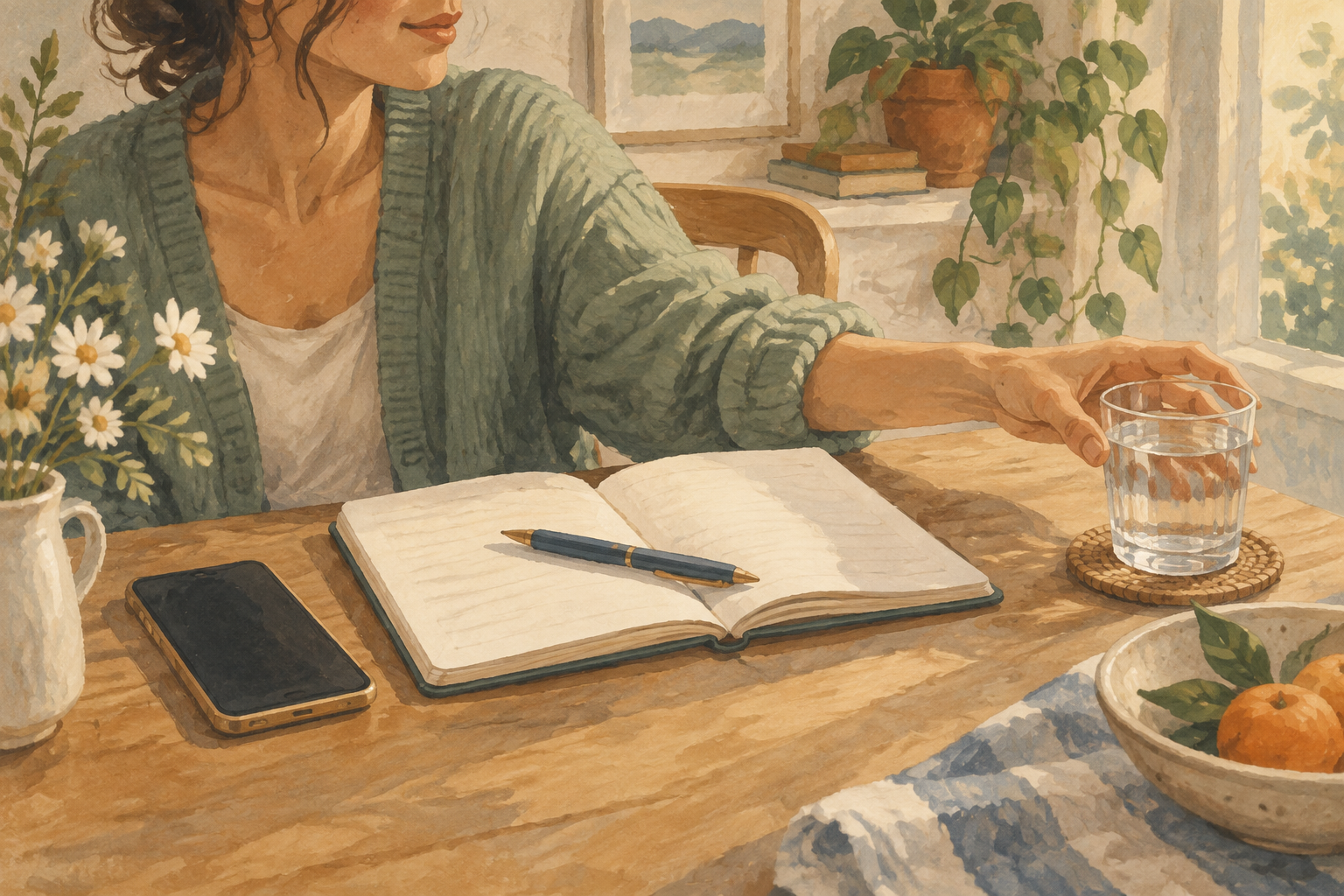
- Try one news-free place, such as the dining table, rather than making your whole home phone-free.
- Decide what you will do after checking: wash a cup, eat something or return to a specific task.
- Review the boundary gently. If it does not fit your life, adjust it rather than treating it as a failure.
4. When your hand reaches for the phone again
Before opening the feed, ask: 'What am I hoping to find this time?' Perhaps you need an actual update. Perhaps you want certainty, company, or a moment away from another difficult task. You do not need to analyse yourself perfectly; even a rough answer can help you choose what to do next.
Try a small interruption rather than a battle of willpower. Put the phone beside you, notice where you are sitting, and name one ordinary thing you can see. Then decide whether to check, wait a little, or do something else. This is a practical pause, not a promise that anxiety will disappear.
If you choose to read, you can still make the visit more deliberate. Open the source you intended to use, look for the information you need, and leave without entering the comments. If you find yourself scrolling again, the next pause still counts. There is no streak to protect and no need to start the whole day over.
5. Turn care into something you can actually carry
Stepping away can bring guilt: 'Other people are living through this. Who am I to take a break?' Their suffering matters. But staying distressed in front of a screen is not the only available expression of concern, and it does not automatically provide the help someone needs.
Where appropriate, choose one bounded action: check on somebody affected, share verified practical information, volunteer through an established organisation, or make a donation you can afford. Verify requests before sending money or personal details. If you have no capacity for action today, that is a limit, not a verdict on your character.
Connection can also matter. WHO includes staying connected with trusted people among its suggestions for coping with stress. That might mean telling a friend, 'I am worried about this, but I do not want to exchange more links tonight.' You can ask for company without opening another round of updates.

6. How Behind 6 can sit alongside you
Behind 6 can be a gentle companion in the gap between closing a news feed and deciding what comes next. You might turn to Stay With Me during a difficult moment, or use My Day to choose one manageable part of the day to return to. You do not need to complete several things for that visit to count.
In the journal, try separating three questions: 'What do I know?', 'What remains uncertain?' and 'What is mine to do today?' My Safe Place can be somewhere to return to if that feels useful. None of this has to become another task you are behind on.
If faith is welcome for you, the Bible area or a short prayer can be part of that pause; Psalm 13:1-4 is one possible passage to explore. Faith is not required, and these tools are not substitutes for professional care or urgent support. You are also free to close the app and choose an offline next step.
7. When to get more help
Consider speaking with a qualified health professional if anxiety keeps disrupting sleep, concentration, eating, work or relationships, or if repeated checking feels increasingly hard to control. You do not have to wait until you are unable to function. NHS stress guidance and NIMH anxiety guidance both support seeking help when symptoms are affecting everyday life.
If reporting repeatedly brings back a frightening event you experienced, mention that connection when asking for support. You could say: 'Since following this story, I have been struggling to sleep and checking for updates throughout the day.' You do not need to arrive with a diagnosis or a polished explanation.
Routes into care differ by country. In the UK, a GP is one starting point; elsewhere, use your local primary-care service or an appropriate licensed mental health professional. If you feel unable to keep yourself safe, contact local emergency services or a crisis line. For immediate danger from the event itself, follow local emergency guidance rather than relying on a news feed.
8. Let the next ordinary thing be enough
You may finish a news check and still feel sad, angry or afraid. A boundary is not a way to make serious events feel unimportant. It is a decision about what you will do with the next few minutes while those feelings are present.
Choose something ordinary and specific: put dinner on a plate, change into comfortable clothes, sit with someone, or prepare what you need for tomorrow. WHO's stress guidance highlights daily routines and sleep as useful areas to support. These are supports, not cures, and they do not require an ideal evening.
Tonight's aim might simply be to leave one update unread until morning, if it is safe to do so. You can return to reliable information at a chosen time. For now, caring about the world and attending to the life immediately around you are allowed to exist together.
Sources and further reading
This article is general information, not medical advice. If you're worried about your health, talk to a doctor.
Keep reading

Anxiety · 8 min
How to Calm Anxiety: One Manageable Moment at a Time
How to calm anxiety with grounding, comfortable breathing and small next steps. Find practical support for anxious moments, without pressure to feel fine.
Read article
Anxiety · 8 min
Feeling Sick After an Anxiety Trigger? What Can Help
Feeling sick after an anxiety trigger? Explore gentle ways to settle your next few minutes, care for your stomach and know when to seek extra medical help.
Read article